Hauntological Anomalistics
Hauntological In-psi-ghts into the Anomalistics of Hegel and Nietzsche's Logic on World-Spirit for Collapse Class

Introduction
Human beings have approached the mystery of creation – or why there is something rather than nothing – and how to make sense of it in a variety of ways. Beyond theological appeals to divinity, natural theology provides a post-speculative framework (defined) which allows us to critically examine two contrasting perspectives: Hegel’s system, based on a structured logic that unfolds through dialectical implication and Nietzsche’s framework, which, by contrast, emphasizes the necessity of forgetting, the danger of historical excess, and the spectral nature of memory. These two positions offer distinct but interrelated approaches to the question of how one might think about structured reality without recourse to divinity: one ascends through dialectical logic; the other descends through spectral critique. Can natural theology, redefined as a post-speculative framework, accommodate both dialectical ascent and spectral descent?
In what follows, this essay will trace the ontological stakes of each of the contrasting perspectives, examine their genealogical emergence, integrate empirical principles from anomalistic psychology to ground the analysis, and offer a means of bridging the gap which is revealed to exist between them by allowing the place and role of the anomalistic in a normalized system to be addressed.
Overview
In this context, natural theology is defined as a rational engagement with structured reality, one that is not primarily centered on human subjectivity but, instead, seeks to understand the logic of Being and its unfolding, while acknowledging that this operates within a metaphysical domain which includes synchrony, mathematical regularity, and contingency as well as diachrony and anomaly.
Within a framework of post-speculative realism which positions itself as a response to correlationism aiming to treat reality as independent of thought, natural theology no longer serves as a bridge to divine revelation but instead functions as a method for tracing the logic of existence through its own internal structures.
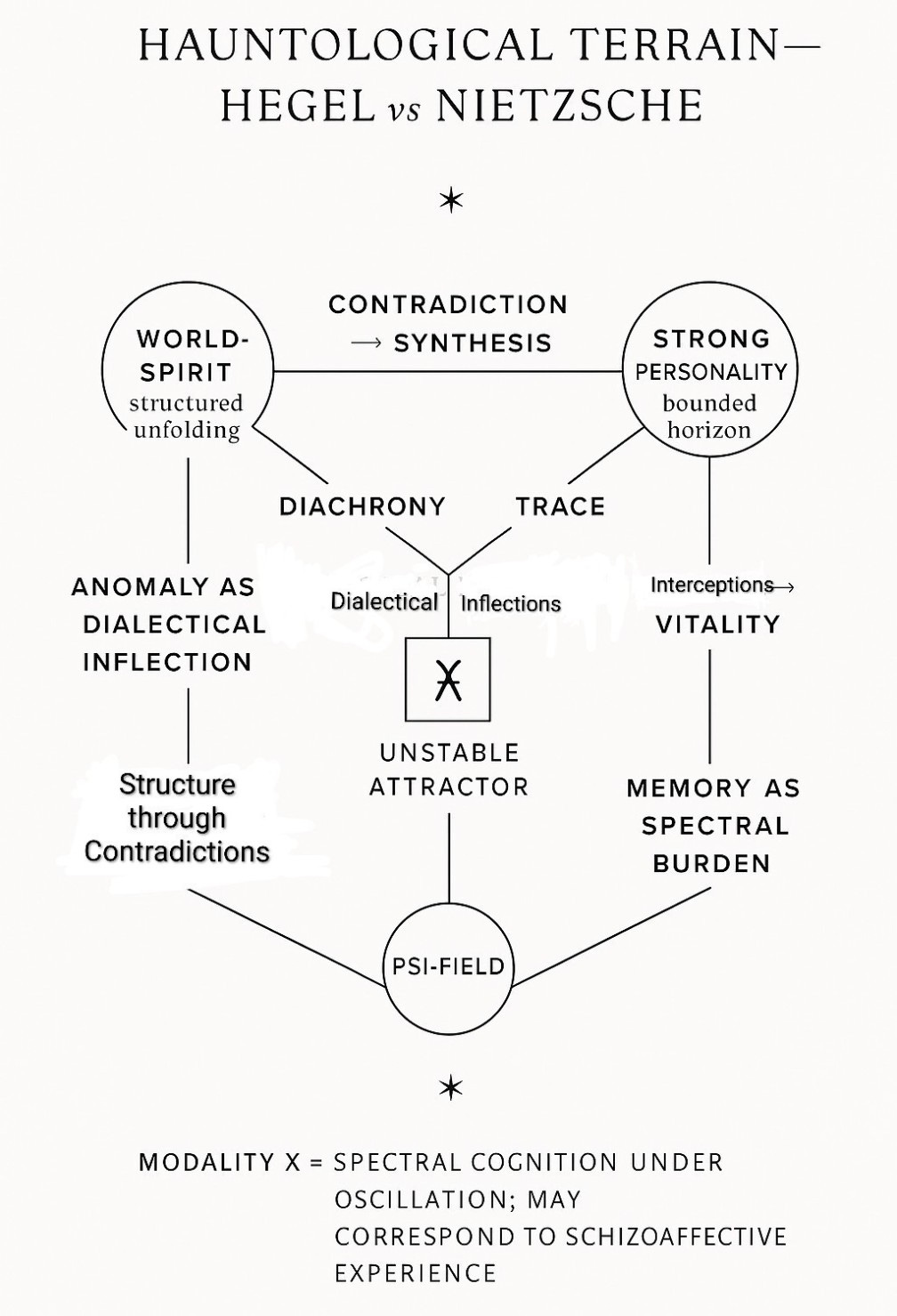
The tension between Hegel and Nietzsche exemplifies the antagonistic structure this approach reveals. Hegel’s dialectical system seeks reconciliation through historical unfolding, treating contradiction as a motor of progress: world-spirit climbs toward self-consciousness. Nietzsche, by contrast, sees history as a burden and proposes the unhistorical and suprahistorical as necessary correctives. Nietzsche’s strong personality resists absorption into historical determinism. Both thinkers engage with the problem of Becoming, but they diverge in their treatment of memory, time, and the role of the subject.
We proceed by examining how each thinker approaches natural theology within their respective frameworks.
Hegel
Hegel’s approach to natural theology begins with the premise that contradiction does not signal failure but rather initiates movement. Within his dialectical logic, contradiction produces synthesis, and synthesis generates further contradiction. This recursive unfolding defines the structure of world-spirit, not as a divine entity, but as a logical mechanism that integrates Being and Non-Being through Becoming. In this view, natural theology does not require a transcendent God, it requires a structured reality that reveals itself through dialectical implication.
World-spirit, as Hegel conceives it, does not remain static. It evolves through stages of self-consciousness, each stage representing a higher form of rational integration. The subject does not merely observe the world, the subject participates in the unfolding of reason. This participation occurs through historical development, where the end of each epoch contributes to the realization of spirit. History, therefore, both lived and reflected on, becomes the complex, self-reflective medium through which natural theology operates, a medium which anomalistically defies understanding through the dialectal approach.
Nietzsche
Nietzsche approaches natural theology not as a system to defend, but as a structure to interrogate. He does not reject the possibility of a structured world; he critiques the orientation that places humanity at its center. In contrast to Hegel’s dialectical ascent, Nietzsche proposes a descent into the spectral logic of memory, where forgetting becomes essential to vitality and historical excess leads to decay.
Nietzsche’s critique of history begins with the observation that modern man suffers from a weakened personality. He argues that history, when consumed without measure, extinguishes the individual. Strong personalities can bear history, weak ones collapse under its weight. This diagnosis does not merely describe a psychological condition—it reveals a metaphysical orientation. Nietzsche views the historical sense as a reactive force, one that subordinates life to memory and critique.
In this framework, natural theology appears not as a rational ascent but as a spectral burden. The past haunts the present, and memory becomes a site of conflict. Nietzsche introduces the concepts of monumental, antiquarian, and critical history to describe different modulations of historical engagement. Monumental history seeks inspiration from the past, antiquarian history preserves it, critical history seeks to destroy it. Each mode reflects a different relationship to memory, and each, being based on the problematic nature of the selective, hauntological, subjective realm of memory, is inherently anomalistic.
Revealing the gap
In this context, natural theology becomes a method for identifying the conditions under which anomaly reveals structure. It does not seek to explain away the anomaly, it seeks to understand its place within a broader logical system. Hegel’s dialectic, while not addressing the nature of the anomalistic directly, provides the scaffolding for understanding it, offering a way to integrate anomaly into the rational unfolding of spirit. The empirical principles of anomalistics ensure that this integration remains grounded, avoiding the pitfalls of magical thinking. The ascent of world-spirit does not occur in isolation: it interacts with anomaly, memory, and empirical observation. It does not claim divinity; it claims structure. It does not promise certainty, it promises intelligibility. Through dialectical implication, world-spirit reveals itself, not as a transcendent force, but as a logical system that includes all its instants as part of a unified whole. There remains an unexplained element regarding the means by which to understand the place of anomalies and the mechanism through which they occur within this system. This ascent defines one side of the argument. Hegel’s dialectical optimism is challenged by the critique of history that Nietzsche proposes as well as the emphasis he puts on memory and forgetting, a challenge that reveals a similar gap in its approach.
Nietzsche argues that a living thing requires a horizon or boundary that allows it to remain healthy and fruitful. Without this horizon, the organism pines away or hastens to its end. This insight does not reject memory; it reconfigures its role. Memory, therefore, must serve life, not dominate it. The unhistorical and the suprahistorical become necessary forces, allowing the individual to navigate existence without becoming trapped in the past.
In this descent, Nietzshe’s natural theology both shapes and transforms through an unexplained mechanism. It no longer seeks to reveal a structured world through rational ascent, it seeks to understand the conditions under which memory becomes spectral and under which forgetting becomes vital. Nietzsche does not offer a system; he offers a deictic position situated in time, challenged by the eternal. He does not promise intelligibility, he demands strength. In the next section, the essay will explore how anomaly, structure, and the role of the subject within a post-speculative framework can be viewed in each of these thinkers’ systems.
Anomaly and structure
The anomalies in both Hegelian and Nietzschean approaches are part of the systems in which they exist. It is as if the systems themselves, by forging a constricting framework on the nature of reality which seeks to understand the nature of Being and Becoming, evoke by definition, internal anomalies. Rather than dismissing them, why not address them?
Drawing from anomalistic psychology, the hauntological anomalistic framework emerges as a genealogical response to the limitations of both speculative realism and classical metaphysics. The framework incorporates empirical principles that restrict claims to those grounded in observable phenomena. The empirical principles of anomalistic psychology provide grounding for this terrain in an approach informed by Marcello Truzzi’s approach to the study of anomalies which has four key functions: evaluation, adjudication, categorization, and neutrality. It evaluates anomaly claims from protoscientists, improves fairness in adjudication, categorizes these claims, and acts as a neutral amicus curiae to science. These principles maintain conventional scientific boundaries while acknowledging that certain phenomena defy subordination to natural law. These principles neither eliminate the possibility of structured reality nor do they eliminate anomaly; by constraining the conditions under which one may recognize it more loosely than other systems might, they allow us to include and examine anomalies and their role in the systems in which they are found; they refine our recognition of such anomalises. Anomalies, in this context, refer to phenomena that defy subordination to natural law while remaining within empirical boundaries. Within this framework, anomaly becomes a signal, not of divinity, but of structure. It does not promise revelation; it demands interpretation.
One way in which hauntological anomalistics reinterprets this process is by introducing the concept of Psi as a parapsychological correlate. Psi does not refer to supernatural forces, it refers to anomalous phenomena that resist reduction to conventional causality. When anomalous phenomena defy subordination to natural law, they signal the presence of a structure not yet understood, and a structure that may correspond to the unfolding logic of world-spirit. In this framework, world-spirit appears as a holographic field: an organic, physical, and informational structure that correlates with anomalous psychology. The dialectical ascent of spirit finds a mirror in the empirical study of anomaly, where structured patterns emerge from seemingly chaotic data.
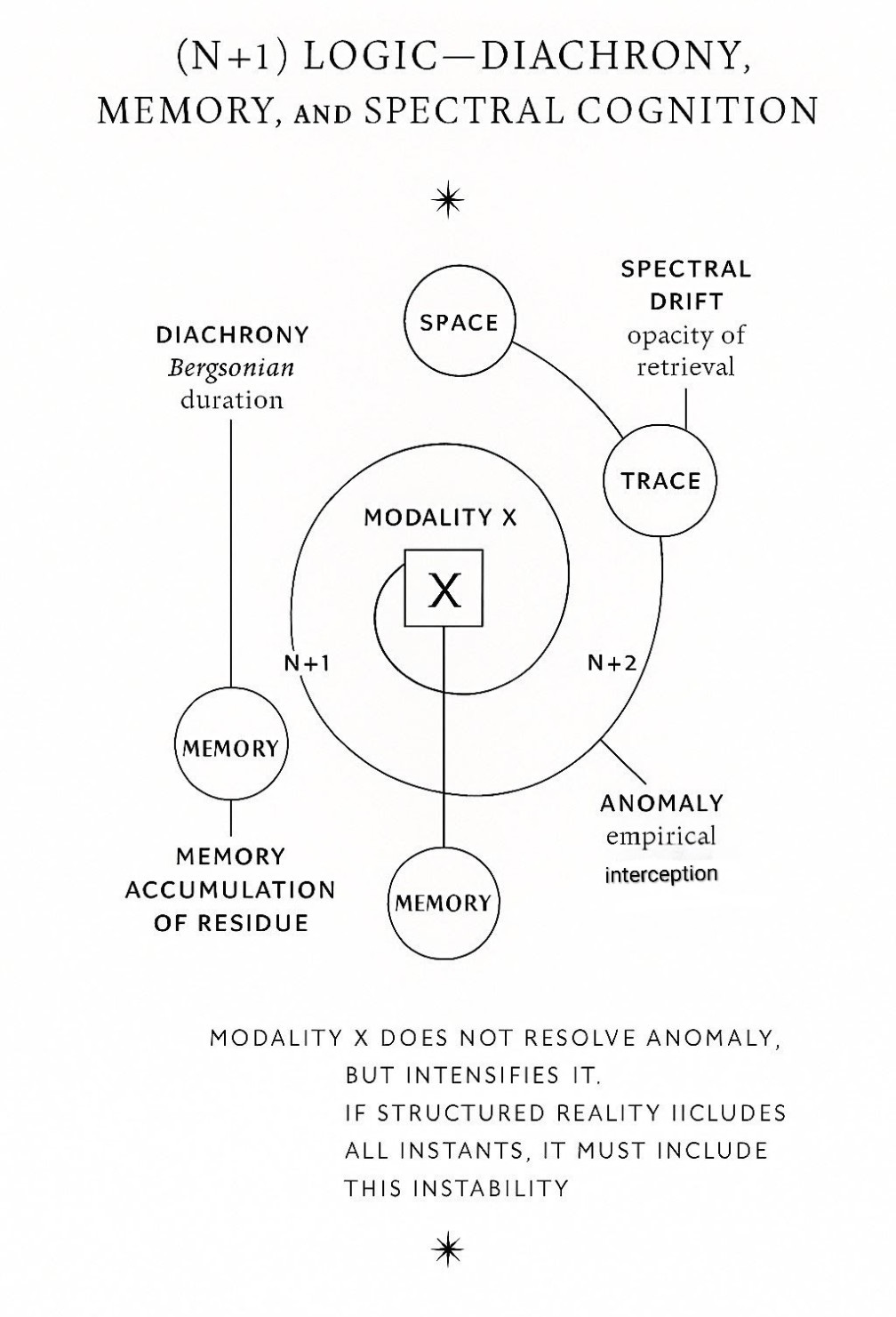
Nietzsche’s program, viewed from the perspective of hauntological anomalistics, does not ascend toward world-spirit, it descends into the abyss of memory, seeking clarity through interceptions. Memory does not function as a stable archive, it operates as a discontinuous loop, a diachronic trace that resists closure. Anomalistic psychology, with its emphasis on empirical boundaries, provides a grounding contrast. It demands that one evaluate claims based on observable phenomena, maintain causality, and avoid metaphysical speculation. Yet even within these constraints, memory reveals itself as a site of anomaly—where retention and retrieval drift apart, and where the past reopens under spectral conditions.
The question then arises as to the link between structure and anomaly; regularity and irregularity, particularly where the system enters itself, either through the reincorporation of ‘synthesis’ as ‘thesis’ with Hegel or through the role that memory plays in Nietzsche’s approach.
The gap to be bridged
The approaches taken by both Hegel and Nietzsche toward anomaly, structure, and the role of the subject are hard to reconcile. Hegel treats anomaly as a moment within a structure realized through and resulting from dialectical progression. He accommodates anomaly by treating it as dialectical contradiction. Contradiction does not disrupt the system; it energizes it. Anomalous phenomena thus become part of the rational unfolding of spirit, temporary interceptions that resolve into higher-order synthesis. The subject participates in this process by recognizing contradiction and integrating it into the unfolding of reason by resolving it within a clearly identified dialectical structure. Nietzsche, by contrast, does not seek resolution, he seeks rupture. He interprets anomaly as a signal of excess, a threat to vitality, not a moment of synthesis. Anomalous phenomena, for him, do not serve as dialectical tools—they resist integration and expose the fragility of systems. Memory, in his view, becomes spectral and haunted by traces that resist closure. The subject does not seek to understand anomaly, it seeks to survive it.
The role of the subject also diverges. Both positions recognize the presence of anomaly, they differ in their response. Hegel’s subject participates in the unfolding of reason, integrating anomaly through dialectical progression, thus subsuming it in the system which expands to include it, thus negating its anomalous nature. Nietzsche’s subject does not ascend through contradiction, the subject resists absorption, maintaining strength through a process of forgetting and the bounding of (and being bounded by) horizons. And yet the strong personality navigates anomaly either by forgetting or choosing not to forget; by enclosing itself within a bounded horizon or by refusing the historical burden that threatens vitality.
These positions reflect different commitments. Hegel commits to intelligibility, synthesis, and the rational unfolding of structure; Nietzsche commits to vitality, rupture, and the preservation of strength. Hauntological anomalistics does not resolve this tension, it maps it. It treats anomaly as a site of philosophical divergence, where structure and interception compete for metaphysical selection.
The question of world-spirit, when refracted through the lens of schizoaffective experience, acquires a new complexity. One cannot simply treat Geist as a rational unfolding of logic or as a spectral trace of memory. Instead, one must consider how world-spirit can be thought of at all under conditions where cognition itself oscillates between clarity and fracture.
As outlined above, hauntological anomalistics is here proposed as a framework for comparing these positions. Hegel offers a logic of ascent while Nietzsche follows with a logic of descent. Hauntological anomalistics provides the terrain on which these logics interact, constrained by empirical principles and haunted by spectral traces. The holographic Psi field captures this integration: in that field, anomaly correlates with structured logic, revealing patterns within apparent chaos. Natural theology, redefined as post-speculative, operates as a method for tracing these patterns.
Straddling the abyss
Schizoaffective experience, with its alternating poles of emotion and perception, introduces a form of anomaly that challenges both dialectical synthesis and spectral critique.
Hegel’s system presumes a subject capable of rational integration. The dialectical ascent requires coherence, even if that coherence emerges through contradiction. Nietzsche’s framework, by contrast, embraces rupture and resists absorption. The strong personality navigates fragmentation by enclosing itself within a horizon. Schizoaffective experience complicates both models. It neither guarantees coherence, nor does it promise strength. It introduces a spectral instability that neither system fully accommodates.
One might ask whether world-spirit can include this instability within its unfolding. If world-spirit refers to a logical mechanism that integrates all instants, then schizoaffective experience must belong to it. Yet this inclusion does not resolve the anomaly—it comsically intensifies it. The subject becomes both participant and interception, both trace and discontinuity.
Hauntological anomalistics does not treat schizoaffective experience as pathology; it treats it as a spectral modality. The condition reveals the limits of rational integration and the necessity of bounded horizons. It does not negate the possibility of structured reality, it reframes the conditions under which one may engage with it.
In this reframing, natural theology becomes a method for navigating instability. It does not promise resolution, it offers orientation. The subject, haunted by memory and anomaly, does not ascend toward synthesis or descend into rupture, it oscillates. This oscillation defines the terrain of hauntological anomalistics, where structure and instability coexist, and where the question of world-spirit remains open.
Transcending the gap
We may now return to the question posed at the beginning: can natural theology, redefined as a post-speculative framework, accommodate both dialectical ascent and spectral descent? The answer does not arrive as resolution, it arrives as recursion. Thought, when viewed through hauntological anomalistics, does not conclude; it loops. It does not stabilize; it adds and subtracts.
Hegel’s ascent through dialectical implication is built on him recognizing a structured reality that integrates contradiction. Nietzsche’s descent into spectral memory reveals his dependence on a structure of fractured reality that resists absorption. Both thinkers engage with the problem of Becoming, but they diverge in their treatment of anomaly, memory, and the role of the subject. Hauntological anomalistics maps their divergence and treats it as a terrain of inquiry – neither succumbing to dialectic or to either oblivion or bounding, but oscillating between the two, leaving them unresolved.
The condition of schizoaffective experience reveals the limits of organic integration and the necessity of bounded horizons. It does not negate the possibility of structured reality; it reframes the conditions under which one may engage with it. The subject, oscillating between clarity and deterritorialization, becomes both participant and interception. World-spirit, if it includes all instants, must include this one.
This inclusion intensifies the anomaly. The subject becomes haunted by their own cognition, and thought becomes a site of spectral instability. Hauntological anomalistics treats this instability not as pathology, but as modality. It does not seek to cure, it seeks to understand. It does not promise coherence, it offers orientation.
The subject, caught between sky (world-spirit) and stone (subject), neither ascends nor descends, it oscillates. It does not seek divinity; it seeks structure. In this movement, natural theology becomes a method, not for explaining reality, but for engaging with it. It becomes a stance, not of belief, but of inquiry.
The recursive invocation begins here. One does not conclude the essay; one reopens it. One does not resolve the tension; one inhabits it. The logic of addition (N+1) defines one characteristic of its movement, yet thought does not arrive at closure; it arrives at growth. Memory does not stabilize; it accumulates residue. Reality does not present itself as presence; it reveals itself as trace.
Post-speculative realism yearns for the Great Outdoors of Hegelian world-spirit, a structured reality independent of thought. Post-spectral realism does justice to the Derridaean trace of memory, revealing the abyss underneath. Hauntological anomalistics integrates both yearnings, constrained by empirical principles and haunted by spectral traces.
I invite the reader to think again, to add and subtract again, to remember again. In this sense, hauntological anomalistics does not resolve the question of natural theology, addition and subtraction rupture it, endlessly.
EDIT:
To make a move at once into the subtractive model, you can read ‘rupture’ as ‘interception’ so that ‘interception’ means a breach in the flux where as ‘rupture’ signals addition. It’s a reflective comparison between the two models.
Sources:
Bensusan, Hilan (2024).
Bensusan, Hilan and Johns, Charlie (2024).
Bensusan, Hilan and Johns, Charlie (2025).
Nietzsche, Fredrich (1874).
Jones and Zusne (1989).